An official website of the United States government
Official websites use .gov A .gov website belongs to an official government organization in the United States.
Secure .gov websites use HTTPS
A lock ( ) or https:// means you’ve safely connected to the .gov website. Share sensitive information only on official, secure websites.
This document highlights Denver’s Department of Transportation and Infrastructure (DOTI) Rapid Response program (RR Program or RR team) and shows how the program takes a systemic approach to safety and aligns with the Safe System principles to achieve Vision Zero in Denver.
The Texas Transportation Commission has adopted a goal of zero fatalities on Texas roadways by 2050. Recognizing that new methods would be needed to reach this goal, the Texas Department of Transportation (TxDOT) retained the Texas A&M Transportation Institute to develop scoring tools that can be used to evaluate the effects of geometric, traffic control and roadside design elements on safety. The initial effort focused on two-lane and multi-lane rural roadway projects because a disproportionate number of fatalities and serious injuries occur on these roads.
The scoring tool incorporates quantified effects of changes in design parameters such as lane and shoulder width, horizontal and vertical curve geometry, rumble strips, and clearances to objects, thereby allowing project developers to examine the effects and tradeoffs involved in design decisions. Developed in a user-friendly, familiar spreadsheet format, the tool is not designed or intended to make decisions for the project developer, but rather to provide an objective, data-driven aid that allows the designer to assess and evaluate how changes in design parameters can affect safety. Feedback is provided through a visualization tornado-chart graph, dubbed the Vortex of Safety, which provides a proportional representation of the effect of design changes, and focuses the analyst on the primary means to improve safety in a project.
Highway Safety Improvement Program (HSIP) funding is usually allocated to projects meeting an established definition of high-crash location. Local systems tend to experience low-crash density, which can be a challenge in qualifying for HSIP funding.
Noteworthy Solution
Thurston County in Washington State has developed a systemic safety analysis approach that can be used by locations with low-crash density and provide Thurston County with a proactive, data-driven, and defensible method of identifying projects eligible for Washington State Department of Transportation (WSDOT) HSIP funding.
This practice is from the FHWA publication "Noteworthy Practices Manual - For Local Agencies Implementing Federal-Aid Highway Safety Improvement Program Projects." Download a PDF of the entire manual or view the HTML version.
The Safety Concern: Outcome evaluations are an important, but often-overlooked, element in demonstrating that safety investments achieved their real-world potential.
The Solution: A thorough review of six years of safety projects.
The Result: Strong, actionable evidence for TDOT showing a 60% reduction in crash frequency overall, and cost-effectively identifying additional locations in need of further study or improvement.
The East-West Gateway (EWG) Council of Governments (COG) has set performance targets to reduce the number of non-motorized fatalities and serious injuries and actively works to meet the targets.
The American Association of State Highway and Transportation Officials (AASHTO) and seven other organizations representing roadway safety professionals in all the States have developed the Toward Zero Deaths (TZD) National Strategy to provide a roadmap of making sure every trip on our nation's highways is safe. The strategy focuses on all aspects of roadway safety, and emphasizes the importance of cooperation and collaboration.
At the same time, there was a growing national emphasis on evaluating and managing performance throughout the highway program. Both the Federal Highway Administration (FHWA) and AASHTO were encouraging states to be proactive in establishing and monitoring performance measures, and working together to improve critical areas such as safety.
“Highway safety partners know that their individual efforts are effective when they collaborate with each other, join forces to attack a particular problem or problem spot from multiple directions, and take advantage of each other's experiences and knowledge. This multidisciplinary approach is the basis of the Toward Zero Deaths National Strategy, as it has been with states' and various other organizations' strategic plans for improving highway safety. TZD is a vehicle to further unite safety stakeholders nationwide and focus on the core elements necessary to bring this shared safety vision to reality.”
- Toward Zero Deaths:
A National Strategy on Highway Safety
The Departments of Transportation (DOTs) in New Hampshire, Vermont, and Maine have a history of collaboration, which can be seen in their planning and operations, and their response to emergencies and other common problems. The three states share a geography, climate, history, culture, and roadway network that speak to their interconnectedness. Given this, it is not surprising that when the challenge was put forward to significantly reduce fatalities and serious injuries, the three States again focused on how they could support each other to achieve these goals.
On August 19, 2010, the three States signed the Tri State Agreement for Standardized Performance Measures Memorandum of Understanding (included in the appendix of the referenced 2013 report). In that memorandum, the three states commit to work together to establish a standardized set of performance measures and targets in safety and other priority areas. At the core of the Safety Performance Measures was the TZD program, which was just beginning to be embraced around the country. In that regard, this effort was not only unique in its multi-state scope, but also in taking such an early lead in adopting the TZD vision (nearly four years before AASHTO's formal adoption of the TZD National Strategy).
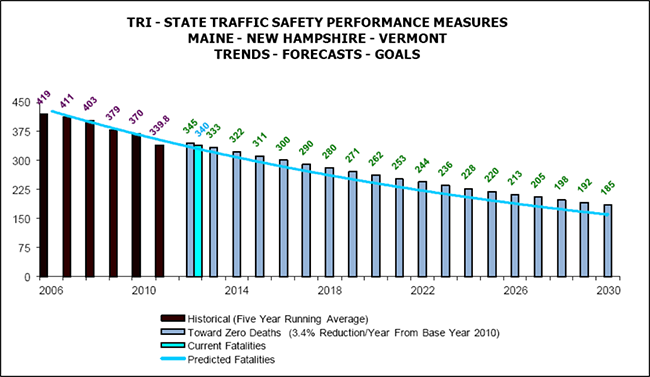
A Tri-State Safety Performance Measure Working Group was formed and provides an ongoing forum for the advancing the states' safety performance efforts. Although each state has its own challenges, they share six Critical Emphasis Areas (CEAs) in their Strategic Highway Safety Plans (SHSPs). These CEAs are focused on speed, safety belts, young drivers, impaired drivers, distracted drivers and intersections. As part of the tri-state initiative, New Hampshire, Maine, and Vermont continue to work collaboratively to coordinate programs to more effectively reach these regional goals. The following graph shows how this collective goal is represented in the Tri-State Performance Measures Annual Report for 2013.
In addition, these three states have worked together with other New England DOTs to regularly share their safety experiences, programs and initiatives. For the past two years, Duane Brunell from MaineDOT has been hosting bi-monthly safety teleconferences which provide an open forum for the exchange of ideas. “We have talked about everything from addressing wrong-way drivers, to bike and pedestrian safety issues,” he notes. “Our states share many of the same safety problems and we continue to learn much from each other.”
Key Accomplishments
New Hampshire, Vermont, and Maine built on their long standing relationship to adopt a common goal for their collective safety programs.
Memorandum of Understanding signed by the heads of the three State DOTs to cooperatively develop common safety performance measures
Early efforts to officially adopt goals and a vision reflecting what would become the Towards Zero Deaths National Strategy
Results
New Hampshire, Vermont, and Maine formally entered into the Tri-State partnership to work towards a common goal of significantly reducing fatalities and serious injuries. Through an on-going work group, the three states continue to focus on their efforts on common emphasis areas in their SHSPs. This has been reinforced through bi-monthy meetings to share experience and knowledge that has expanded beyond the original three States to include safety professionals from all the New England DOTs.
Contacts
Bruce Nyquist, P.E.
Highway Safety Manager
Vermont Agency of Transportation
(802) 828-2696
Fax: (802) 828-2437 Bruce.Nyquist@vermont.gov
Duane Brunell
Safety Manager
Maine Department of Transportation
16 Statehouse Station
Augusta, Maine 04333
(207) 624-3278 Duane.Burnell@maine.gov
The Washington practice is discussed after the following introduction about Strategic Highway Safety Plan (SHSP) evaluation.
Other states in this SHSP Evaluation Noteworthy Practices series: ID and NV
Planning for Evaluation Should Begin When the SHSP is Developed
The Highway Safety Improvement Program (HSIP) requires States to evaluate their Strategic Highway Safety Plan (SHSP) to ensure the accuracy of their SHSP priorities and proposed strategies. Furthermore, evaluation helps States answer basic questions about the progress of their SHSP such as:
What are we trying to do?
How well are we doing it?
How can we improve?
States that have successfully integrated evaluation into their SHSP process have realized the opportunity it provides to strengthen their SHSP efforts. Benefits include demonstrating the SHSP's contribution to transportation safety; uncovering challenges in prioritizing or implementing programs and strategies; determining progress in meeting SHSP goals and objectives, and; validating emphasis areas and strategies, or revealing the need to revise them.
Following are examples of how States have put evaluation into action.
Outcome performance measures: how they will measure progress towards their goals and objectives.
Priority strategies: those evidence-based or promising strategies that have the greatest potential to help them reach the emphasis area goals and objectives.
Output performance measures: activity measures that help document program implementation.
It is never too early to institute evaluation; in fact, planning for evaluation should begin when the SHSP is developed. During the early stages of SHSP development attention should be given to how progress will be measured and success determined.
Washington's Practice
Washington Develops an Evaluation Plan
Washington State has developed an evaluation plan for their 2013-2016 SHSP, which they call Target Zero.
In their Target Zero plan, Washington documented how they intended to develop an evaluation plan to guide their SHSP evaluation. Early in 2014, representatives from the Washington State Department of Transportation (WSDOT) and the Washington Traffic Safety Commission (WTSC) convened to determine how to facilitate the overall SHSP evaluation.
“FHWA's assistance in creating the framework for evaluating our SHSP has been central to getting that work off the ground. We've discussed evaluation as a priority but weren't able to make it happen until FHWA offered their expertise and technical tools. Our partnership with FHWA has helped jumpstart a meaningful evaluation of our SHSP.”
- Chris Madill, Deputy Director
Washington Traffic Safety Commission
Washington decided it would conduct a performance evaluation to determine how effective the SHSP has been in meeting its goals and objectives (outcomes), and the status of the implementation of their SHSP strategies (outputs). The evaluation plan captures these elements, which track back to their SHSP:
Goal(s) and objectives
Outcome performance measures: how they will measure progress towards their goals and objectives
Priority strategies: those evidence-based or promising strategies that have the greatest potential to help them reach the emphasis area goals and objectives
Output performance measures: activity measures that help document program implementation
Tracking and data needs: the data they need to track the strategies and who will be responsible for coordinating this data
Washington also uses a tracking tool to record progress in meeting their goals and objectives and the status of their implementation activities.
Washington plans to use their evaluation results to help guide the development of their SHSP update, particularly the strategies in the next plan. It will also use the results to provide updates to partners such as National Highway Traffic Safety Administration (NHTSA) and Governors Highway Safety Association (GHSA), to inform leadership on key initiatives, and inform the Governor's office and legislators.
Figure 1. Washington SHSP Implementation and Output Tracking Tool
See these other SHSP Evaluation Noteworthy Practices:
The Idaho practice is discussed after the following introduction about Strategic Highway Safety Plan (SHSP) evaluation.
Other states in this SHSP Evaluation Noteworthy Practices series: NV and WA
Planning for Evaluation Should Begin When the SHSP is Developed
The Highway Safety Improvement Program (HSIP) requires States to evaluate their Strategic Highway Safety Plan (SHSP) to ensure the accuracy of their SHSP priorities and proposed strategies. Furthermore, evaluation helps States answer basic questions about the progress of their SHSP such as:
What are we trying to do?
How well are we doing it?
How can we improve?
States that have successfully integrated evaluation into their SHSP process have realized the opportunity it provides to strengthen their SHSP efforts. Benefits include demonstrating the SHSP's contribution to transportation safety; uncovering challenges in prioritizing or implementing programs and strategies; determining progress in meeting SHSP goals and objectives, and; validating emphasis areas and strategies, or revealing the need to revise them.
Following are examples of how States have put evaluation into action.
Outcome performance measures: how they will measure progress towards their goals and objectives.
Priority strategies: those evidence-based or promising strategies that have the greatest potential to help them reach the emphasis area goals and objectives.
Output performance measures: activity measures that help document program implementation.
It is never too early to institute evaluation; in fact, planning for evaluation should begin when the SHSP is developed. During the early stages of SHSP development attention should be given to how progress will be measured and success determined.
Idaho's Practice
Idaho Develops an Evaluation Plan
Recognizing the importance of SHSP evaluation, Idaho embarked on the development of an evaluation plan in the early stages of their 2013-2016 SHSP. To develop the evaluation approach, the Idaho Transportation Department (ITD) convened a two-day workshop that included the input of Focus Group Committee Chairs, the SHSP Executive Oversight Team, the Office of Highway Safety Manager, the SHSP Manager, and FHWA. During the workshop, the evaluation team identified performance measures for emphasis area goals and objectives as well as for priority strategies. The team determined the data they would need to monitor their progress, established a tracking tool, and assigned roles and responsibilities for the various evaluation components. These elements are captured in an evaluation plan document that the team will continue to reference over the life of their SHSP.
The Focus Group Chairs are taking the lead on tracking SHSP implementation and monitoring progress towards goals and objectives. Their tracking tool generates a summary sheet, which is used to inform leadership and to report on their progress at their regular SHSP team and committee meetings.
In general, their evaluation results are used to monitor progress and identify areas of success as well as those needing improvement. Modifications will be made as warranted.
Results are also used to:
Inform leadership, such as for the annual report out on the highway safety program
Inform and involve SHSP oversight team
Make “course corrections” to strategies or strategy implementation (if warranted)
Help orient new SHSP members
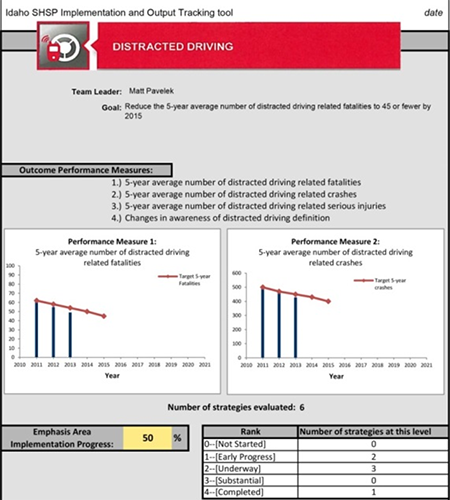
Figure 1. Idaho SHSP Implementation and Output Tracking Tool
See these other SHSP Evaluation Noteworthy Practices:
The Nevada practice is discussed after the following introduction about Strategic Highway Safety Plan (SHSP) evaluation.
Other states in this SHSP Evaluation Noteworthy Practices series: ID and WA
Planning for Evaluation Should Begin When the SHSP is Developed
The Highway Safety Improvement Program (HSIP) requires States to evaluate their Strategic Highway Safety Plan (SHSP) to ensure the accuracy of their SHSP priorities and proposed strategies. Furthermore, evaluation helps States answer basic questions about the progress of their SHSP such as:
What are we trying to do?
How well are we doing it?
How can we improve?
States that have successfully integrated evaluation into their SHSP process have realized the opportunity it provides to strengthen their SHSP efforts. Benefits include demonstrating the SHSP's contribution to transportation safety; uncovering challenges in prioritizing or implementing programs and strategies; determining progress in meeting SHSP goals and objectives, and; validating emphasis areas and strategies, or revealing the need to revise them.
Following are examples of how States have put evaluation into action.
Outcome performance measures: how they will measure progress towards their goals and objectives.
Priority strategies: those evidence-based or promising strategies that have the greatest potential to help them reach the emphasis area goals and objectives.
Output performance measures: activity measures that help document program implementation.
It is never too early to institute evaluation; in fact, planning for evaluation should begin when the SHSP is developed. During the early stages of SHSP development attention should be given to how progress will be measured and success determined.
Implementation Status for Strategy:
Enforce pedestrian laws at high crash locations;
pursue judicial follow through.
Funding secured from a Nevada Joining Forces grant to augment enforcement related to pedestrian safety and speed.
Courts were briefed on potential changes in the law to improve pedestrian safety. [Update! Nevada was successful in changing laws to improve pedestrian safety in the 2015 legislative session, which was due to the efforts of the Pedestrian Critical Emphasis Area and Pedestrian Task force. These laws included the use of “Pedestrian Safety Zones” and making it illegal to pass or make U turns in an active school zones.]
Regional high visibility enforcement campaigns were conducted throughout the year, which included an on-going program of Police Officers dressed in seasonal themed costumes in crosswalks in high crash locations in Las Vegas (i.e., Thanksgiving turkey, Santa, Leprechaun, etc.).
Support and coverage from media partners to get out the safety message, e.g. ABC Channel 13's (Las Vegas) “Be Smart, Be Safe, Be Seen” campaign for crosswalk safety.
A Bill Draft Request for Nevada's 2013 Legislative Session was prepared that includes six recommended changes to the Nevada Revised Statutes (NRS) to benefit pedestrian safety.
Source: Nevada SHSP Annual Report. 2013
In 2012, Nevada's SHSP Critical Emphasis Area (CEA) teams adopted a series of performance measures to track the impact of strategies adopted by each CEA (for their 2012-2016 SHSP), all of which tie to the number of fatalities and serious injuries.
The Nevada SHSP objectives were set as five-year average number of fatalities and serious injuries with 2008 (average of 2004 to 2008) as the baseline year. Nevada compiles their results into an Annual Report. The report shows progress for their performance measures and supporting data. It also summarizes the activities implemented to support the SHSP strategies.
The shaded content is an excerpt from Nevada's January 2013 Annual Report for their Pedestrian critical emphasis area. They document their safety progress towards a reduction in fatalities and serious injuries as well as provide the implementation status of their strategies.
Safety Progress on Pedestrians Fatalities and Serious Injuries
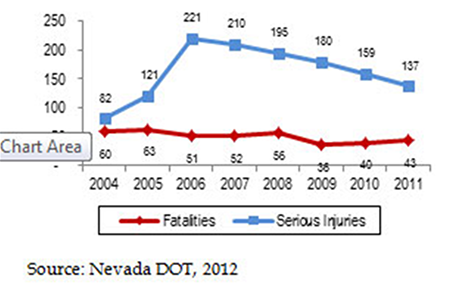
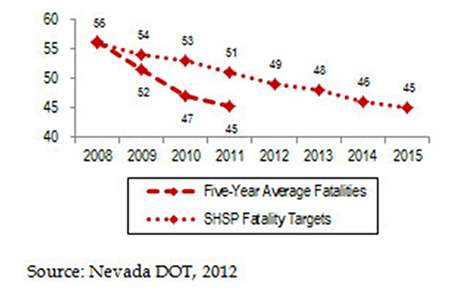
Between 2008 and 2011, pedestrian fatality numbers dropped by 23.2 percent and serious injuries decreased by 29.7 percent (Figure 3). The five year average number of pedestrian fatality and serious injuries both ended up lower than their targets (Figure 4).
Figure 3. Pedestrian Fatalities and Serious Injuries
Figure 4. Five Year Average Pedestrian Fatalities/Serious Injuries
See these other SHSP Evaluation Noteworthy Practices: