Meet the SHRP2 Utilities Bundle
Utility conflicts can present major delays, costs, and headaches for transportation agencies, but avoiding them just got easier.

An official website of the United States government

Official websites use .gov
A .gov website belongs to an official government organization in the United States.

Secure .gov websites use HTTPS
A lock ( ) or https:// means you’ve safely connected to the .gov website. Share sensitive information only on official, secure websites.
Utility conflicts can present major delays, costs, and headaches for transportation agencies, but avoiding them just got easier.
When Atlanta's I–85 bridge catastrophically collapsed, Federal and State transportation agencies joined forces with contractors and suppliers to rebuild in record time.
 As summer heat gives way to changing leaves and cooler temperatures, we are easing back into the season of pumpkin spice lattes, trick-or-treating, and the end of daylight saving time.
State and local agencies embrace new norms throughout the fourth round of Every Day Counts.
Current conditions and changing demands across the Nation necessitate innovative thinking to finance infrastructure improvements that are vital to helping communities thrive. Value capture helps communities complete projects before they otherwise might be able to and is one method for State and local highway agencies to pay for infrastructure needs.
The United States and the Republic of Korea have a long-standing program to exchange transportation knowledge and ideas.
Technology is evolving rapidly in the highway transportation industry. One way to help keep pace is for transportation agencies to share knowledge and successes—even between countries.
Automation is transforming mobility. Cooperative driving automation (CDA) supports and enables automated vehicles to cooperate through communication between vehicles, infrastructure devices, and road users, such as pedestrians, bicyclists, and scooters. CDA has the potential to improve transportation efficiency, facilitate freight movement, increase productivity, and save billions of dollars in the reduced need to increase roadway facilities. Most importantly, CDA has the potential to reduce crashes caused by human error and save lives.
FHWA researchers developed a robotic air-coupled acoustic system to reduce traffic delays and increase safety when collecting data to assess condition.
USDOT is leading the way for research, design, and implementation of a security system for connected and automated vehicle networks.
During a 2-year study, FHWA took a closer look at the state of the practice for using unmanned aircraft systems (UAS) for bridge inspections.
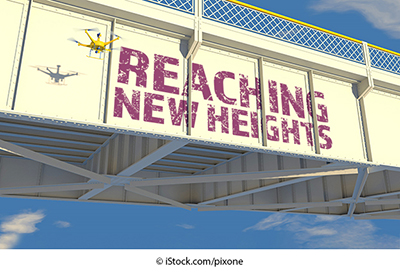
Unmanned aircraft systems offer inspectors another tool for assessing the condition of bridges.